
Your kitchen serves as the heart of the home, and its cabinets anchor the entire space. Solid wood kitchen cabinets offer timeless appeal and lasting durability, making them a wise investment for any project. How do you navigate the vast array of wood species, construction methods, and finishes to find the perfect fit? This kitchen cabinet guide provides expert-driven answers for both designers and homeowners. Informed by industry leaders like HenLeap Home, you’ll gain actionable insights for confident decisions.
Solid wood kitchen cabinets increase a home’s resale value by an average of 7-10% compared to engineered wood cabinets, based on 2026 real estate industry data.
Solid wood delivers enduring value that transcends trends.
Key Takeaways
- Solid wood cabinets increase home value and last over 50 years.
- Choose stock, semi-custom, or custom cabinets based on budget and timeline.
- Select wood species like oak, maple, or cherry for durability and beauty.
- Quality construction with dovetail joints and soft-close hardware ensures long life.
- Maintain 30-55% humidity to keep wood cabinets stable.
Types of Kitchen Cabinets: A Starting Point
Before you select a wood species or finish, you must decide which category of cabinetry fits your project. The three main types of kitchen cabinets—stock, semi-custom, and custom—differ significantly in cost, lead time, and flexibility. Understanding these distinctions helps you align your choices with client expectations and project timelines.
Stock, Semi-Custom, and Custom Options
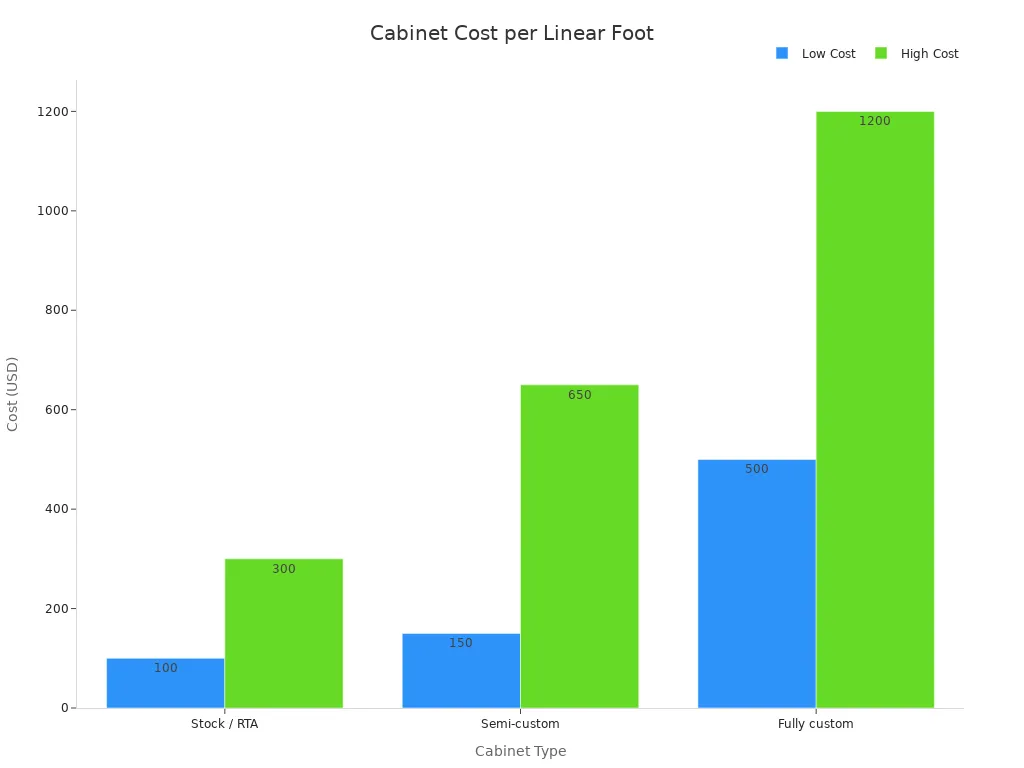
Stock cabinets come pre-manufactured in standard sizes with limited finish options. Manufacturers build them in bulk, which keeps prices low. You might pay $60 to $200 per linear foot for these units. Their availability makes them attractive for quick renovations, with delivery taking days to about two weeks. However, you sacrifice design flexibility. You cannot request unique dimensions, specialized wood species, or distinctive hardware.
Semi-custom kitchen cabinets offer a middle ground. Manufacturers produce them in standard sizes but allow modifications to height, width, and finish. You gain more control over the final appearance without the full expense of bespoke construction. Expect to invest $100 to $650 per linear foot, with lead times of four to eight weeks. This category suits designers who need specific aesthetics without waiting months for completion.
Fully custom kitchen cabinets provide complete creative freedom. You specify every detail, from wood species to joinery to interior fittings. This option demands patience, as lead times run eight to sixteen weeks or longer. Costs range from $500 to $1,500 per linear foot, reflecting the craftsmanship and premium materials involved. For high-end projects, this investment delivers exactly what you envision.
| Cabinet Type | Lead Time |
|---|---|
| Stock | Days to about 2 weeks |
| Semi-Custom | 4 to 8 weeks |
| Custom | 8 to 16+ weeks |
How Cabinet Type Influences Wood Choice
Your cabinet category directly determines which wood species you can specify. Stock options typically feature oak or maple because these woods suit mass production. Semi-custom lines expand your choices to cherry, hickory, or birch, depending on the manufacturer’s catalog. Custom kitchen cabinets allow any solid wood species you desire, including walnut or mahogany.
The budget also shapes your material selection. Solid wood kitchen cabinets represent the premium end of the market, often costing $150 to $500 per linear foot before installation. Homeowners seeking durability might choose oak for its hardness. Designers aiming for a luxurious aesthetic might select cherry or walnut for their rich grain patterns.
For projects requiring unique specifications, HenLeap Home offers custom solutions tailored to your design vision. Their team provides 2D and 3D virtual designs, allowing you to visualize how different wood species and finishes will appear in your space. This service bridges the gap between concept and reality, ensuring your chosen materials and styles align perfectly with your creative direction.
Best Wood for Kitchen Cabinets: Key Factors
Selecting the best wood for kitchen cabinets requires more than matching a color swatch. You must evaluate how each species performs under daily use, how it responds to your climate, and what maintenance it demands over decades. These factors determine whether your cabinets remain beautiful for years or show premature wear.
Durability, Hardness, and Grain
Hardness measures a wood’s resistance to dents, scratches, and impact. The Janka scale provides a standardized rating for this property. Higher numbers indicate harder wood. Your kitchen sees constant activity—doors open, drawers slide, pots clatter. Softer woods may show dents and marks quickly. Harder species withstand this abuse gracefully.
Grain pattern affects both appearance and practical performance. Open-grain woods like oak display prominent pores and texture. Closed-grain woods like maple and cherry offer smooth, uniform surfaces. Your choice depends on the aesthetic you want and how much texture you desire under your fingertips.
Interior designers consistently recommend three species for their balance of durability and visual appeal:
- Oak – Designers call this a ‘workhorse hardwood’ because it is strong, dense, and forgiving under daily use. Red oak features a bold, open grain pattern. White oak presents a straighter grain. Both suit traditional and modern designs equally well.
- Maple – This species offers a fine, closed grain with a pale, even tone. Its versatility makes it a top pick. Maple accepts paint and stain exceptionally well, producing a clean, uniform surface that complements any style.
- Cherry – Referred to as a ‘luxurious wood,’ cherry has a closed and fine grain. Its durability matches its beauty. Cherry deepens in color over time, developing a rich patina that adds elegance and character to your kitchen.
These three species represent the sweet spot between toughness and aesthetics. They handle high-use areas without sacrificing visual appeal.
Cost, Maintenance, and Climate Suitability
Your budget shapes your species selection. Oak typically costs less than cherry or walnut. Maple falls in the mid-range. Exotic woods command premium prices. Remember that solid wood kitchen cabinets represent an investment. The type of wood for kitchen cabinets you choose affects both upfront costs and long-term value.
Maintenance requirements vary by species. Closed-grain woods like maple and cherry resist dirt accumulation in their surfaces. Open-grain woods like oak may trap debris in their pores, requiring more thorough cleaning. All solid wood benefits from periodic conditioning to maintain its finish and prevent drying.
Climate plays a critical role in wood performance. Wood expands and contracts with humidity changes. In humid environments, choose stable species like maple or cherry that resist moisture absorption. In dry climates, oak performs admirably. You should also consider your home’s heating and cooling patterns. Seasonal humidity swings stress any wood, so proper sealing and finishing become essential.
Quality construction matters as much as species selection. Well-built cabinets use proper joinery and reinforcement. HenLeap Home uses quality construction techniques for lasting durability. These details ensure your chosen materials perform as intended.
The best wood for kitchen cabinets balances hardness, grain aesthetics, cost, and climate response. No single species wins every category. Your project’s specific needs determine the ideal choice. Evaluate your priorities, consider your environment, and select a wood that serves both function and beauty.
Popular Solid Wood Species Compared
Choosing the right wood transforms your kitchen design. Each species brings unique characteristics that affect appearance, durability, and cost. Understanding these differences helps you match the material to your project’s style and functional needs. The three most popular wood types for kitchen cabinets fall into two categories: classic choices and distinctive options.
Oak, Maple, and Cherry: Classic Choices
Oak, maple, and cherry have proven their value over decades of use. These woods offer reliable performance and timeless beauty. They suit a wide range of kitchen cabinet styles from traditional to contemporary.
Solid wood cabinets—especially those crafted from oak, maple, or cherry—are the gold standard. With proper care, these quality cabinets can last over 50 years.
Oak stands out for its prominent open grain. Red oak is the most forgiving wood of the group. Because it’s a true hardwood with a strong, open grain, it absorbs stain evenly and predictably, no matter the color. Even lighter stains show up clearly and don’t look washed out. Oak works well for rustic and traditional kitchen cabinet styles. Refinishing oak costs between $1,200 and $4,000. You may need grain filler for a smooth painted finish.
Maple features a dense, closed grain. This tight grain makes it ideal for painted finishes and modern, smooth surfaces. However, staining maple can be tricky due to uneven absorption. Refinishing costs range from $1,500 to $5,000. Maple’s hardness and uniform appearance suit contemporary designs. The tight grain also makes it harder to sand, so plan for additional labor.
Cherry takes stain exceptionally well, enhancing its natural deep reddish hues. Painting cherry is less common because it covers the wood’s natural beauty. Refinishing costs fall between $1,500 and $6,000. Cherry develops a rich patina over time, darkening with age and exposure to light. This natural evolution adds elegance to formal and luxurious kitchens.
| Wood Type | Cost Range (Refinishing) | Stain Absorption Characteristics | Painting Considerations |
|---|---|---|---|
| Oak | $1,200 – $4,000 | Absorbs stain evenly, enhancing the prominent grain; ideal for rustic, textured looks. | May require grain filler to smooth the coarse grain for a sleek painted finish. |
| Maple | $1,500 – $5,000 | Dense grain can lead to uneven stain absorption, making it tricky to stain consistently. | Tight grain paints well, ideal for modern, smooth finishes; harder to sand. |
| Cherry | $1,500 – $6,000 | Takes stain exceptionally well, enhancing its natural deep reddish hues. | Painting is less common as it covers the wood’s natural beauty, but a sleek finish is still achievable. |
Hickory, Walnut, and Birch: Distinctive Options
For projects that demand a unique statement, hickory, walnut, and birch offer distinctive alternatives. Each wood brings a different personality to your kitchen.
Hickory ranks as the hardest of the three with a Janka rating of 1,820 lbf. Its extreme durability makes it the top choice for high-traffic areas. The dramatic two-tone appearance ranges from creamy white to reddish-brown. This bold grain suits rustic or lodge styles. The dramatic color variation makes hickory non-uniform and challenging to work with, increasing custom costs. Custom hickory cabinets cost $500 to $1,200 per linear foot. Its tight grain resists stain well, but the visual busyness limits it to statement applications.
Walnut commands the highest premium of all common species. Despite a lower Janka hardness of 1,010 lbf, its smooth, refined grain and deep chocolate-brown tones justify the price. Walnut’s straight, smooth grain works beautifully for statement islands and modern luxury kitchens. The dark color shows scratches more easily, so consider this for lower-traffic areas. The premium pricing reflects its beauty and desirability.
Birch offers a fine, straight, uniform grain with a light neutral color. With a Janka rating of 1,260 lbf, it falls between the other two in hardness. Birch is budget-friendly and often substitutes for maple. It handles dark stains unevenly but works well for painted cabinets and clean, modern aesthetics. Custom birch cabinets cost in the lower range. Its uniform appearance makes it a practical choice for projects where consistency matters more than natural drama.
| Wood Type | Janka Hardness (lbf) | Cost Range (per linear foot, custom) | Grain & Appearance | Best For |
|---|---|---|---|---|
| Hickory | 1,820 | $500 – $1,200 | Bold, dramatic two-tone (creamy white to reddish-brown); tight grain resists stain | High-traffic kitchens, rustic/lodge style |
| Walnut | 1,010 | Highest of all common species | Smooth, refined, chocolate-brown with swirling grain; naturally dark | Statement islands, modern luxury |
| Birch | 1,260 | Lower range (budget-friendly) | Fine, straight, uniform grain; light neutral color; takes paint/stain well | Painted cabinets, budget-conscious projects |
A brief note on pine: this softwood offers a budget-friendly entry point for solid wood cabinets. However, its softness makes it prone to dents and scratches. Pine works best in low-traffic spaces or for clients who appreciate a distressed, rustic look.
The best wood for kitchen cabinets depends on your style, budget, and functional requirements. Each type of wood for kitchen cabinets serves a specific purpose. The finishes you choose also affect the final appearance and durability. Consider your priorities carefully before making a selection.
Solid Wood vs. Engineered Materials
Understanding Plywood and MDF
Solid wood comes from a single tree. Plywood and MDF are engineered materials. They combine wood fibers or layers with adhesives to create stable boards.
Plywood consists of thin wood veneers glued in alternating directions. This cross-grain structure creates exceptional strength. Plywood resists warping and cracking better than natural wood in many conditions. Many cabinet boxes use plywood for its stability. You pay more for plywood than MDF but less than natural wood.
MDF stands for medium-density fiberboard. Manufacturers break wood into fine fibers and mix them with resin under heat and pressure. The result is a dense, uniform board. MDF has no grain pattern. This smooth surface makes it ideal for painted finishes. No texture shows through the paint. However, MDF lacks the structural strength of plywood or natural wood. It can sag under heavy loads over time.
The lifespan differences are significant. Solid hardwood cabinets last over 50 years. Plywood cabinets serve you well for 25 to 30 years. MDF cabinets typically last 10 to 15 years. Your choice of kitchen cabinet materials directly affects the longevity of your kitchen. When you compare options, consider how long the client expects the renovation to last.
Construction Quality Indicators
Beyond the material itself, construction quality determines durability. Look for dovetail joinery in drawer boxes. This interlocking joint provides exceptional strength where the drawer sides meet the front. Dovetail joints resist the stress of daily opening and closing.
Plywood bottoms in drawers add another layer of durability. Thin hardboard or MDF bottoms can warp or detach over time. Plywood bottoms hold their shape and support heavier loads.
Soft-close mechanisms represent a premium feature. These hinges and slides prevent doors and drawers from slamming. They operate smoothly and quietly. Soft-close hardware extends the life of your kitchen cabinets by reducing wear on joints and frames.
HenLeap Home exemplifies this level of craftsmanship. Their cabinets feature reinforced construction throughout. Quality joinery ensures long-term performance. Smooth-close doors and drawers come standard. These details transform a good cabinet into a great one.
When you evaluate options for your kitchen, examine the construction. Solid wood offers the longest lifespan. But well-built engineered products with proper joinery and hardware can serve your projects well. The best choice balances budget, aesthetics, and durability for each specific client.
Finishes and Care Tips
Choosing the Right Finish
The finish you select determines both appearance and longevity. Oil-based finishes penetrate deep into the grain, offering a warm, rich tone that highlights natural wood character. Water-based finishes dry clear and resist yellowing over time, making them ideal for light woods like maple or birch. Lacquer provides a hard, durable surface that sprays on smoothly, but it requires professional application for best results.
A weekend DIY project with a brush, a roller, and wall paint from the hardware store is one product. A professional refinish with industrial preparation and sprayed cabinet-grade coatings is another product entirely, and they age on completely different timelines. Typical DIY cabinet paint jobs commonly start showing wear within two to five years… A professional refinish is a different story, with a realistic expectation of roughly 10 to 15 years of good looks under normal family use and often longer with reasonable care.
The finish compatibility of kitchen cabinet wood types matters significantly. Open-grain woods like oak accept penetrating oils beautifully, while closed-grain species like cherry respond better to film-forming finishes. Consider how each finish interacts with your chosen wood before committing.
| Finish Type | Expected Lifespan (Normal Household Use) |
|---|---|
| Professional 2K polyurethane (spray applied) | 10–20 years |
| Store-bought 1K enamel (e.g., BM Advance, SW Emerald) | 3–6 years |
| DIY latex or chalk paint | 1–3 years |
Your kitchen cabinet finishes choice affects maintenance demands. Professional-grade finishes resist moisture and scratches better than store-bought alternatives. For high-traffic kitchens, invest in sprayed polyurethane or catalyzed lacquer. These finishes withstand daily wear without showing premature aging.
Maintenance and Climate Care
Solid wood responds to its environment. Temperature and humidity fluctuations cause expansion and contraction. Proper care extends the life of your cabinets and preserves their beauty.
- Recommended conditions: Keep temperature between 70-75°F and relative humidity between 30-55% to sustain the natural moisture level in cabinetry.
- Low humidity effect: Solid wood door center panels shrink, revealing an unfinished line along the edge.
- To increase humidity: Use portable humidifiers (cool mist or warm mist), place water containers near radiators, or install a forced-air humidifier on the furnace.
- To decrease humidity: Use a dehumidifier (especially in basements), run exhaust fans while cooking, open windows during bathing, and use air conditioning in summer to introduce drier air.
- Winter (low humidity): Dry air from heating systems causes wood to shrink, leading to cracking, separation of face frame joints, warping, and visible unfinished lines on door panels.
- Summer (high humidity): Wood absorbs moisture and expands in thickness and width, causing doors to rub, panels to break from expansion pressure, and joints to crack or warp.
- Recommended range: Maintain 30-55% RH year-round; optimal care is 35-50% RH. Keep humidity above 20% when temperatures drop below 20°F.
- Protective methods: Insulate the back of cabinets, seal gaps with weather stripping, add foam insulation panels inside cabinets, insulate under-sink areas, and keep cabinets away from direct heat sources.
- Low humidity effect: When relative humidity drops below 20% (which is below the 30% threshold in the query), solid wood doors and center panels shrink, leading to visible unfinished lines and joint separation.
- High humidity effect: When relative humidity exceeds 70-80% (above the 50% threshold), cabinet joints swell, doors and drawer fronts become swollen, and butt doors fail to close properly.
- Recommended range: Maintain 30-55% relative humidity to keep wood cabinetry stable and problem-free.
- Control methods: Run heating, cooling, and humidification systems consistently; ensure proper insulation and vapor barriers; use a digital hygrometer to monitor levels.
Cleaning your kitchen cabinets requires gentle methods. Use a soft, damp cloth with mild soap. Avoid abrasive cleaners that scratch the finish. Wipe spills immediately to prevent moisture damage. Apply furniture polish sparingly to maintain luster without buildup.
Monitor humidity with a digital hygrometer. Adjust your home’s systems seasonally. These simple habits protect your investment and keep your kitchen beautiful for decades.
Sustainable Sourcing and Eco-Friendly Options
Certifications and Responsible Forestry
You want cabinets that look beautiful and align with your values. Sustainable sourcing starts with understanding where your wood comes from. The Forest Stewardship Council (FSC) certification stands as the gold standard for responsible forestry. This independent organization verifies that forests are managed with strict environmental, social, and economic standards. When you see the FSC label on a wood product, you know the harvest did not contribute to deforestation or habitat destruction.
Verifying sustainable sourcing requires asking the right questions. Request documentation from your supplier that traces the wood back to its origin. Ask whether they hold chain-of-custody certification. This certification tracks wood from the forest floor to the finished product. You can also look for the Programme for the Endorsement of Forest Certification (PEFC), another credible certification system. These labels give you confidence that your kitchen design does not harm the planet.
Balancing Cost and Sustainability
Sustainable materials often carry a higher price tag. FSC-certified wood typically costs more than uncertified alternatives. This premium reflects the cost of responsible forest management and independent audits. You must weigh this expense against your client’s budget and your project’s sustainability goals. Many homeowners willingly pay more for eco-friendly kitchen cabinets when they understand the environmental impact.
You can balance cost and sustainability through smart material choices. Consider domestic hardwoods like maple or oak, which require less transportation energy than imported species. These woods also support local economies and reduce your carbon footprint. You might also explore reclaimed wood options, which give new life to old materials and add unique character to your kitchen.
HenLeap Home supports sustainable practices across its product lines. The company sources materials responsibly and emphasizes durable construction that extends cabinet lifespan. Longer-lasting cabinets mean fewer replacements and less waste over time. When you choose quality materials that endure, you make an environmentally sound decision. Your kitchen becomes a statement of both style and stewardship.
Your Solid Wood Kitchen Cabinet Checklist
You now have the knowledge to make confident decisions. This checklist turns that knowledge into action. Follow these steps to move from concept to completed installation without costly surprises.
From Budgeting to Installation
Start with your budget. Industry best practices recommend allocating a significant portion of your total kitchen remodel budget to cabinetry. This percentage ensures you invest enough in the most visible and heavily used element of the space. Write this number down before you explore options.
Next, measure your space carefully. Record ceiling height, wall length, and window placements. Note any irregularities in floor or wall angles. Accurate measurements prevent expensive adjustments later. Share these dimensions with your supplier.
Select your type of wood for kitchen cabinets based on your style, durability needs, and climate. Match the species to your design vision. Consider how each wood responds to your local humidity levels. Your choice affects both appearance and longevity.
Work with a supplier who offers design support. HenLeap Home provides 2D and 3D virtual designs. These tools let you visualize your kitchen before production begins. You can test different materials, styles, and finishes without committing to physical samples. This step saves time and reduces miscommunication.
Review the construction details before ordering. Confirm dovetail drawers, soft-close mechanisms, and reinforced cabinet boxes. These features define the quality of your cabinets. Verify them in writing.
Finally, schedule delivery and installation. Confirm lead times with your supplier. Prepare your space for the installation crew. Clear countertops and protect floors. A smooth installation process protects your investment.
Common Pitfalls to Avoid
Several mistakes trip up even experienced designers. Avoid these common errors to keep your project on track.
- Ignoring climate factors: Wood expands and contracts with humidity. Choose a species suited to your region. Install proper ventilation and maintain 30-55% relative humidity year-round.
- Choosing the wrong finish: Match your finish to your wood species and usage level. Open-grain woods accept penetrating oils well. Closed-grain woods respond better to film-forming finishes. Professional-grade finishes last longer than store-bought alternatives.
- Skipping the design review: Always request 2D and 3D renderings. Visualizing your custom kitchen cabinetsprevents costly mistakes. Review every detail before production begins.
- Prioritizing price over quality: The cheapest option rarely delivers lasting value. Solid wood cabinets represent a long-term investment. Quality construction and materials pay off over decades of use.
Your checklist now covers every phase. Use it to guide your decisions. With careful planning, your kitchen will serve you beautifully for years.
You now possess the knowledge to select solid wood kitchen cabinets with confidence. The best choice balances aesthetics, durability, and budget for each unique project. Your specific needs, style preferences, and environmental factors determine the ideal wood species. No single answer works for every kitchen.
Use the checklist as your practical guide. It walks you through budgeting, measuring, and selecting materials. Avoid common pitfalls by following each step carefully. You have the tools to make informed decisions.
Solid wood endures beautifully for decades. Homeowners appreciate its lasting value and timeless appeal. HenLeap Home partners with you to bring your vision to life. Their quality craftsmanship and comprehensive support ensure your kitchen reflects your design excellence.
FAQ
How Do I Choose Between Oak, Maple, and Cherry?
Your choice depends on your design vision and practical needs. Oak offers bold grain and exceptional durability for rustic or traditional kitchens. Maple provides a smooth, uniform surface ideal for modern painted finishes. Cherry delivers rich, warm tones that deepen beautifully over time, perfect for formal spaces.
What Humidity Level Keeps Solid Wood Cabinets Stable?
Maintain relative humidity between 30-55% year-round. Below 30%, wood shrinks and cracks appear. Above 55%, panels expand and doors stick. Use a digital hygrometer to monitor conditions. Adjust with humidifiers or dehumidifiers seasonally to protect your investment.
How Long Do Solid Wood Cabinets Last Compared to Engineered Options?
Solid hardwood cabinets can last over 50 years with proper care. Plywood cabinets serve 25-30 years. MDF cabinets typically last 10-15 years. Your material choice directly impacts longevity. Quality construction with quality joinery, sturdy drawer bottoms, and smooth-close mechanisms extends lifespan regardless of material.
What Construction Details Signal Premium Quality?
Look for quality drawer joints, sturdy drawer bottoms, and smooth-close mechanisms. These features indicate reinforced construction that withstands daily use. Quality cabinets incorporate these features. These details separate lasting craftsmanship from disposable alternatives.
Can I Mix Different Wood Species in One Kitchen?
Absolutely. Many designers combine a statement wood like walnut for an island with maple perimeter cabinets. This approach adds visual interest while managing costs. Ensure your finishes complement each other. Consider how each species responds to light and humidity before committing to a mixed design.