
You stand before your beloved wardrobe, running your fingers over scratches and faded edges. Sentiment pulls you toward preservation, yet you crave a fresh aesthetic. When your customizable wardrobes show wear, do you refinish the existing pieces or invest in a full replace?
This guide dissects that decision, examining cost, time, durability, and customization potential. You’ll learn when a simple refresh preserves your piece’s soul and when a complete transformation better serves your evolving storage needs. You’ll also discover when a custom solution outweighs sentimental attachment.
Throughout, cabinetry professionals from HenLeap Home share practical insights, helping you make a confident, informed choice for your space and lifestyle.
Key Takeaways
- Refinishing suits structurally sound wardrobes when you want a fresh look on a budget.
- Replacement offers superior durability and customization, lasting 15-20 years or more.
- Assess your wardrobe’s structure first: water damage or rot demands replacement.
- Refinishing costs less and takes days, while replacement takes weeks but transforms your space.
- Choose the option that aligns with your long-term needs and environmental values.
Understanding Restoration vs. Refinishing for Customizable Wardrobes
Before you decide between restoration or refinishing, you must grasp the core distinction. Restoration focuses on repairing and preserving the original material. Refinishing involves stripping away the old surface and applying a new one. This difference and why it matters shapes every subsequent decision about your wardrobe’s future.
Restoration: Preserving the Original Character
Furniture restoration prioritizes maintaining historical integrity. You work with the original finish whenever possible, addressing structural issues like loose joints, cracked panels, or water damage. The goal involves returning the piece to its former glory without erasing its authentic character. For your customizable wardrobes, restoration makes sense when the existing layout still serves your storage needs perfectly.
Proper restoration extends beyond surface repairs. You must adopt preservation habits that protect the original finish for decades. Store garments in a cool, dry place away from direct sunlight. Use breathable cotton or acid-free covers instead of plastic to prevent moisture and mildew. Regular inspections help you catch discoloration, weakened seams, or pest damage early. Gentle cleaning with mild detergent avoids harsh chemicals that can damage delicate fibers. Air dry garments whenever possible. For major repairs, consult textile restoration experts to ensure proper handling.
| Storage Method | Recommended Practice | Avoid |
|---|---|---|
| Hanging | Use padded plastic hangers shaped like shoulders; cover with cloth or plastic with open bottom for air circulation | Wooden hangers (acid content) and metal hangers (insufficient support) |
| Flat storage | Use for heavy beaded gowns or stretch fabrics; stuff loose parts with acid-free tissue paper | Storing costumes with folds and creases |
| Dummy storage | Use mannequins with proper undergarments (bustles, panniers) for shape support | Unsupported loose parts |
| Accessories | Stuff bonnets/gloves with acid-free tissue; store in archival boxes; keep fans/parasols half-open | Closed or fully open positions that stress fabrics |
Refinishing: Transforming the Surface Appearance
Refinishing takes a different path. You strip away the existing finish completely, then apply a new finish that can dramatically alter the wardrobe’s appearance. This approach suits pieces where the structure remains sound but the aesthetics no longer match your vision. You might choose a lighter stain, a bold paint color, or a modern matte sealant.
The process mirrors refinishing kitchen cabinets in many ways. You sand down surfaces, apply primer, and build up multiple coats. Repainting kitchen cabinets follows the same principle—transformation through surface renewal. Similarly, repainting kitchen cabinets allows homeowners to change their space without replacing solid cabinetry. When you refinish, you refresh the visual impact while keeping the original footprint. However, you cannot change internal configurations like shelf heights or drawer sizes. If your storage needs have evolved, refinishing only addresses the surface, not the functionality. Understanding this limitation helps you determine whether a simple refresh suffices or whether you need deeper changes.
Cost Analysis: Refinishing vs. Replacing Your Wardrobe
Budgeting for Professional Refinishing Services
Professional refinishing offers a cost-effective update for your customizable wardrobes. The total cost for a full job averages around $625, with ranges between $335 and $917. Labor accounts for 50 to 85 percent of this expense. Hourly rates fall between $40 and $100 depending on your location.
Material costs vary by wardrobe size and type. For wood furniture, you might spend between $100 and $3,800 per item on materials. Repairs before refinishing typically add $110 to $260, while cleaning services range from $105 to $215. These costs matter when you compare the cost of refinishing to the cost of repainting kitchen cabinets. You can also replace kitchen cabinets entirely, but that costs more. The same logic applies to kitchen cabinets as it does to your wardrobe.
Refinishing costs significantly less than replacement. A professional refinish can last for many years with proper care. This makes it one of the most budget-friendly options for updating your storage. When you choose to refinish rather than replace, you save money while preserving the original structure.
Calculating the Investment in a New Wardrobe System
Replacing your wardrobe requires a larger upfront investment. Several factors drive the total cost. Size and layout complexity matter most. A 4-foot reach-in closet costs a fraction of a large walk-in system. Material quality also plays a major role. Standard laminate over MDF offers the most cost-effective durable option. Natural wood veneer represents a premium choice for luxury spaces.
Door and drawer front styles, hardware upgrades, and installation scope also affect the price. Flat slab fronts cost less than shaker profiles or glass inserts. Accessories like jewelry trays, pull-out valet rods, and LED lighting add individual costs. Structural changes, such as moving walls or adding electrical outlets, can add $1,000 to $3,000 or more.
A high-quality replacement may have a higher upfront cost. However, it offers extended durability and modern features like dovetail drawer construction. These features add long-term value. When you decide to replace rather than refinish, you gain a fresh structural lifespan. The same principle applies when you repaint kitchen cabinets or choose a full cabinet replacement. Evaluate both the immediate cost and the lasting benefits before making your choice.
Time and Disruption: Which Option Fits Your Schedule?
Your daily routine matters when choosing between restoration paths. Refinishing and replacement demand different time commitments and create different levels of disruption in your home. Understanding these timelines helps you plan around work schedules, family needs, and seasonal constraints.
The Refinishing Timeline: Dust and Downtime
Refinishing your wardrobe requires patience and preparation. You must first disassemble the unit completely. Doors come off their hinges. Drawers slide out from their tracks. Hardware like knobs and pulls gets removed and labeled. This preparation alone takes several hours.
The actual refinishing process spans multiple days. You sand every surface to remove the old finish. Then you apply primer and wait for it to dry completely. Each coat of paint or stain needs adequate curing time between applications. Most professional refinishing jobs take multiple days from start to finish. Some complex pieces with intricate details may require additional time.
During this period, your bedroom becomes a workspace. Dust particles float through the air. Strong chemical odors from strippers and finishes permeate your living space. You cannot use the wardrobe or access your clothes inside it. You need alternative storage solutions for your garments during this downtime. Many homeowners schedule refinishing during vacation weeks or when they can tolerate temporary inconvenience. This process resembles what you experience when refinishing kitchen cabinets—the same dust, the same waiting periods, the same temporary chaos.
The Replacement Process: From Demolition to Installation
Replacement follows a longer but more predictable timeline. The process begins with professional measurement of your space. You then select materials, finishes, and internal configurations. For custom orders from manufacturers, production typically takes two to four weeks. Standard sizes may ship faster, but custom dimensions require additional manufacturing time.
Delivery and installation add another week to the schedule. Professional installers remove your old wardrobe carefully. They patch and prepare walls where necessary. Then they assemble and mount your new unit. The entire replacement process spans several weeks from initial consultation to final installation.
The disruption pattern differs from refinishing. You lose access to your wardrobe only during the final installation day. However, you must plan around delivery windows and installation appointments. The extended timeline means you wait longer for your new storage solution. Yet the actual hands-on disruption compresses into a shorter period. If you need a quick refresh of your space, refinishing delivers faster results. But if you can tolerate a longer wait, replacement offers a complete transformation without weeks of dust and chemical fumes in your living space.
Durability and Longevity: Assessing the End Result
When you invest time and money into your wardrobe, you want the results to last. Both refinishing and replacement offer different durability profiles. Understanding these differences helps you weigh immediate savings against long-term performance.
Lifespan of a Refinished Surface
A properly refinished surface can serve you well for many years with consistent care. This timeframe depends heavily on the quality finish applied and how you maintain it. Daily use takes its toll. Keys in pockets scratch surfaces. Belt buckles graze drawer fronts. Humidity causes wood to expand and contract, stressing the new finish.
Refinished surfaces remain susceptible to chipping and wear over time. Unlike factory-applied finishes cured under controlled conditions, refinishing happens in your home environment. Temperature fluctuations and airborne dust can compromise adhesion. You might notice small chips near edges or fading in areas exposed to direct sunlight. These imperfections worsen gradually, eventually requiring another refinishing cycle.
For homeowners who plan to move within a few years, refinishing offers adequate longevity. The surface will look fresh during your remaining time. However, if you intend to stay in your home for decades, you may face multiple refinishing cycles. Each cycle costs money and creates disruption. Consider whether repeated investments make sense for your situation.
Structural Integrity of a New Wardrobe
A new wardrobe offers a fresh structural lifespan of 15 to 20 years or more. This longevity stems from modern construction methods and quality materials. Premium wardrobes use quality joinery techniques like dovetail and mortise-and-tenon joints to extend product life.
The joinery quality determines how long your wardrobe maintains its structural integrity. Premium wardrobes feature dovetail joints at drawer corners. These interlocking connections create mechanical locks that resist tension perpendicular to the joint face. Half-blind dovetails support over 100 pounds of load and last beyond 20 years. Quality mid-range options use dowel joints with three to four dowels per corner, supporting 75 to 100 pounds for 15 to 20 years.
| Construction Type | Corner Joint | Load Capacity | Expected Lifespan |
|---|---|---|---|
| Premium | Dovetail (half-blind) | 100+ lbs | 20+ years |
| Quality Mid-Range | Dowel (3–4 per corner) | 75–100 lbs | 15–20 years |
| Standard Production | Staple + glue | 50–75 lbs | 10–15 years |
| Economy | Staple or cam lock | 25–50 lbs | 5–10 years |
Mortise-and-tenon joints provide the strongest connection for frame construction. They resist racking forces in both axes, keeping your wardrobe square through years of opening and closing. When properly executed with adequate glue surface, these joints withstand decades of operation without loosening.
This structural advantage translates directly to long-term results. A new wardrobe from a reputable manufacturer delivers dependable performance without the recurring maintenance costs of refinishing. You also gain features that reduce wear on moving parts. While the initial investment exceeds refinishing costs, the extended lifespan often delivers better value over time. The same logic applies when you compare refinishing kitchen cabinets versus replacing them entirely. Kitchen cabinets endure similar daily wear, and their construction quality determines their useful life. Choosing durable construction for your wardrobe mirrors the smart decision you would make for your kitchen cabinets.
Customization Potential: Adapting to Your Evolving Needs
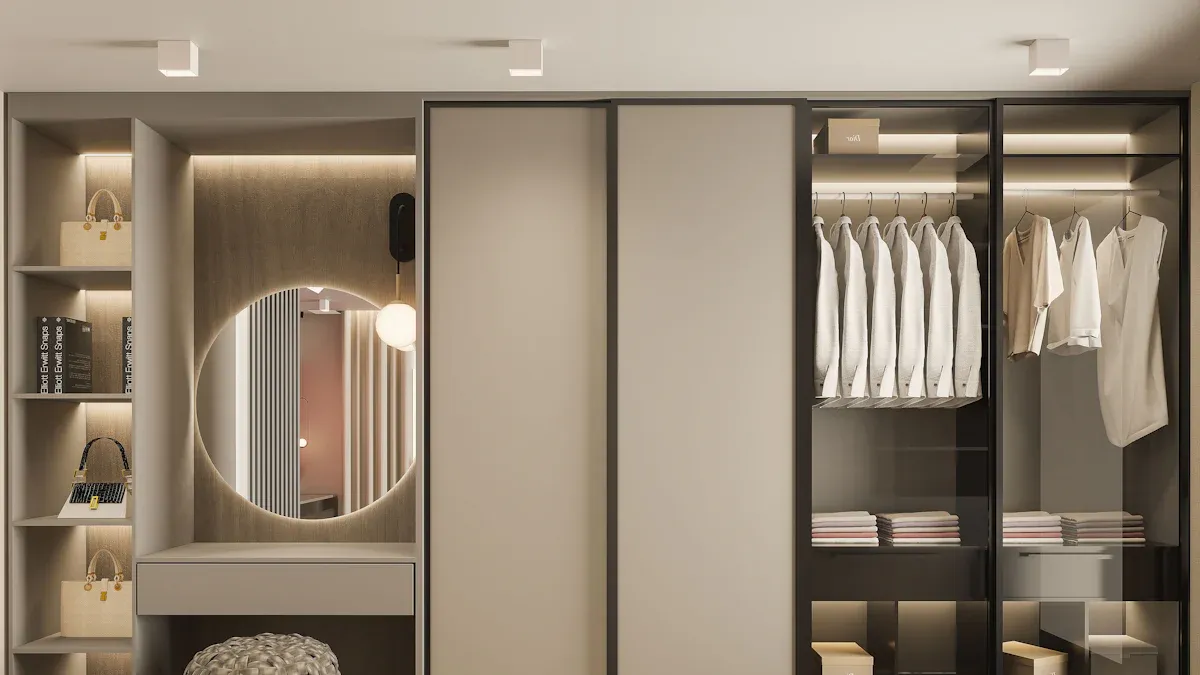
Your storage requirements shift as your life changes. A growing family demands more hanging space. A new hobby requires specialized compartments. Your wardrobe must adapt to these evolving needs. The question becomes whether refinishing or replacement offers the flexibility you require.
Working Within the Existing Wardrobe Framework
Refinishing delivers a visual refresh without altering your wardrobe’s internal structure. You can change the color from oak to white. You can apply a matte finish instead of glossy. These surface changes transform the appearance completely. However, the bones remain identical. Shelf heights stay fixed at their original positions. Drawer sizes remain unchanged. The hanging rod stays exactly where the manufacturer placed it.
This limitation matters when your storage patterns have shifted. Perhaps you now own more folded sweaters than hanging garments. Maybe your shoe collection outgrew the original cubbies. Refinishing cannot solve these spatial problems. You work within the existing framework, adjusting only the aesthetics. For some homeowners, this constraint feels acceptable. They simply need a fresh look. For others, the inability to reconfigure internal storage creates frustration. You must honestly assess whether your current layout still serves your daily routines before committing to a refinishing project.
Unlocking New Layouts with a Full Replacement
Replacement opens unlimited possibilities for internal configuration. You design the storage around your actual belongings rather than forcing items into predetermined spaces. Adjustable shelving lets you modify shelf heights as your collection changes. Pull-out racks provide easy access to accessories. Specialized drawers accommodate jewelry, ties, or folded garments with dedicated compartments.
This level of customization extends beyond the wardrobe itself. A full replacement allows you to coordinate your bedroom storage with other spaces in your home. You might choose a fully customized kitchen approach for your culinary areas while matching your wardrobe to the same aesthetic. The same design language flows throughout your living spaces. This complete kitchen transformation mirrors what you can achieve in your bedroom when you start fresh. You select every detail, from internal fittings to door hardware. You create a storage solution that genuinely fits your life rather than adapting to someone else’s design assumptions. The investment in a custom system pays dividends through daily convenience and satisfaction.
Environmental Impact: The Eco-Conscious Choice
Your decision reaches beyond your bedroom walls. Every choice carries environmental consequences that accumulate over time. Understanding these impacts helps you align your wardrobe update with your values.
Reducing Waste Through Refinishing
Refinishing stands as the inherently more sustainable path. You keep your existing wardrobe out of landfills. You avoid the energy-intensive process of manufacturing new materials. The wood frame, drawers, and hardware all remain in service rather than becoming waste.
Consider the numbers. A typical wardrobe contains substantial wood and hardware. When you discard it, those materials require disposal. Landfills receive bulky furniture that takes decades to decompose. The manufacturing process for a replacement wardrobe demands fresh lumber, adhesives, hardware, and packaging. Each component carries its own environmental cost.
Furniture restoration through refinishing reduces demand for new raw materials. You extend the useful life of existing resources. This approach aligns with circular economy principles that prioritize reuse over replacement. When you refinish, you also avoid the transportation emissions associated with delivering a new wardrobe from factory to your home. The environmental savings multiply across every stage of the product lifecycle.
The Carbon Footprint of Manufacturing New Materials
Replacement inherently consumes more resources. New wardrobes require harvested timber, processed wood products, metal hardware, and chemical finishes. Factories consume energy during production. Trucks burn fuel during delivery. Your old wardrobe adds to waste streams.
However, you can offset these initial environmental costs through smart choices. A durable, long-lasting product from a responsible manufacturer delivers better environmental value over time. When you purchase a wardrobe built to last 20 years, you avoid repeated replacement cycles. Each avoided replacement represents significant resource savings.
Quality construction, including dovetail drawer joints, extends product lifespan. Additionally, modern mechanisms reduce wear on moving parts. These features mean your wardrobe serves you longer, spreading the environmental cost across many years of use.
The key question becomes one of lifecycle thinking. A cheap wardrobe that fails in five years creates more waste than a quality piece that lasts two decades. When you choose replacement, prioritize durability over initial savings. Your environmental footprint depends less on whether you refinish or replace, and more on how long your chosen solution endures.
Making the Right Call for Your Kitchen Cabinets and Wardrobes
The decision you face with your customizable wardrobes mirrors a familiar dilemma in another part of your home. Homeowners constantly weigh refinishing kitchen cabinets against replacing kitchen cabinets entirely. The same logic applies to both situations: you must assess the “bones” before you consider cosmetics. A beautiful surface cannot fix a failing structure. A fresh layout cannot emerge from a rigid frame. Understanding this principle guides you toward the right choice for your space.
A Step-by-Step Assessment Framework
Professionals follow a structured approach when evaluating cabinetry. You can apply the same framework to your wardrobe decision.
First, check your cabinet boxes. Inspect every surface for water damage, soft spots, warping, or mold. Press gently on corners and edges. Look for discoloration that signals moisture intrusion. If the boxes remain structurally sound, a refinish offers a viable path forward. If you find damage, replacement becomes necessary. A compromised frame cannot support a new finish reliably.
Second, consider your layout. Ask yourself whether the current configuration serves your daily routines. Does the hanging space accommodate your garments? Do the shelves hold your folded items comfortably? If the layout works and you only want aesthetic changes, refinishing delivers what you need. If you dream of moving the sink in your kitchen or adding an island, you need replacing kitchen cabinets instead. The same principle applies to your wardrobe. When you need different shelf heights or additional drawers, only a full replacement provides that flexibility.
Third, set your budget. Refacing saves you 30–50% compared to full replacement. This cost difference matters when you plan your finances. If budget constraints dominate your decision, refinishing offers maximum value for your investment. You transform the appearance without the expense of new construction. If your budget allows a complete overhaul, replacement provides full design freedom. You select every detail from materials to hardware.
Fourth, think about your timeline. Refacing typically takes 1–3 days. Replacement spans several weeks from measurement through installation. If minimizing disruption matters most, refinishing keeps your life moving smoothly. You tolerate brief dust and odors rather than weeks of waiting. If you can accommodate a longer process, replacement rewards your patience with a completely renewed space.
When Replacement is the Clear Winner
Certain situations leave no doubt about the right path. Water damage that compromises structural integrity demands replacement. Rotting wood or broken joints cannot be repaired cosmetically. You must address the underlying failure. The same applies to kitchen cabinets with warped frames or crumbling particleboard. No amount of repainting kitchen cabinets will restore their function.
Layout inadequacy also signals replacement. When your storage needs have outgrown the existing configuration, refinishing only postpones the inevitable. You need a system designed around your actual belongings. A kitchen makeover that reconfigures your workspace requires new cabinetry. Similarly, a wardrobe that cannot accommodate your growing collection needs a fresh design.
For those leaning toward replacement, consult a professional before committing. You visualize your new space before you invest. You see exactly how your chosen materials and configurations will appear. This preview eliminates guesswork and ensures satisfaction with your cabinet replacement options.
Remember that restoration preserves what works while replacement transforms what does not. Evaluate your structure honestly. Consider your long-term needs. Then choose the path that serves you best. Whether you pursue a simple refresh or a complete transformation, your decision should reflect your actual circumstances rather than trends or pressure.
Refinishing offers a cosmetic, budget-friendly solution for structurally sound wardrobes. You transform the surface appearance without altering the framework. Replacement represents a structural investment. You gain enhanced customization options and extended longevity of 15-20 years or more.
Evaluate your wardrobe’s structural integrity first. Check for water damage, rot, or broken joints. Then consider your long-term storage needs and aesthetic desires. A compromised frame demands replacement. An outdated layout signals the same conclusion.
Trust your specific situation. No universally wrong answer exists—only the wrong choice for your unique circumstances. Seek professional advice for a definitive assessment. You visualize your options clearly before committing to a refresh or full transformation.
FAQ
Can I refinish my wardrobe myself to save money?
You can attempt DIY refinishing. Professional results require skill and experience. Improper technique leads to peeling or uneven coating. Professional refinishing costs $335 to $917 and delivers durable, attractive results.
What signs indicate my wardrobe frame is too damaged for refinishing?
Check for water stains, soft spots, mold, or warping. Press corners and edges firmly. Look for discoloration from moisture. A solid frame accepts a new finish well. Damaged wood needs full replacement for structural safety.
Does refinishing remove scratches and surface imperfections?
Sanding removes minor scratches and shallow marks during refinishing. Deep gouges need wood filler before applying the finish. Severe damage may remain visible even after careful refinishing work.
Can I add new shelves or drawers during a refinish?
No. Refinishing only transforms the surface appearance. Shelf heights and drawer sizes remain unchanged. To reconfigure storage spaces for your changing needs, choose full replacement instead of refinishing.
How long does professional refinishing take compared to replacement?
Professional refinishing takes several days. You cannot use the wardrobe during this time. Replacement spans several weeks from measurement to installation. However, active disruption compresses into a single installation day.