
You’ve pinned a dozen photos of teal kitchen cabinets. You love the color. You just don’t know where to start. That’s a common spot to land. Teal brings real personality to a dream kitchen, yet it plays well with many styles and surfaces. The right shade can feel calm or bold, coastal or modern. Your first step is simple: gather samples and study them in your own light. HenLeap Home offers inspiration and guidance to help you choose with confidence. Pick a shade you love, then build the room around it. A few smart decisions turn that spark of an idea into a space you’ll enjoy for years.

Key Takeaways
- Test large teal samples in morning, afternoon, and evening light to see how the color changes.
- Choose your coverage: full teal, two-tone, or island only, based on your kitchen size and light.
- Pair teal cabinets with white quartz or marble countertops and gold hardware for a stylish look.
- Match the teal shade and door style to your kitchen’s style, from modern to farmhouse.
- Clean teal cabinets with mild soap and water, and avoid harsh cleaners to keep them looking fresh.
Decoding Teal Shades and Undertones
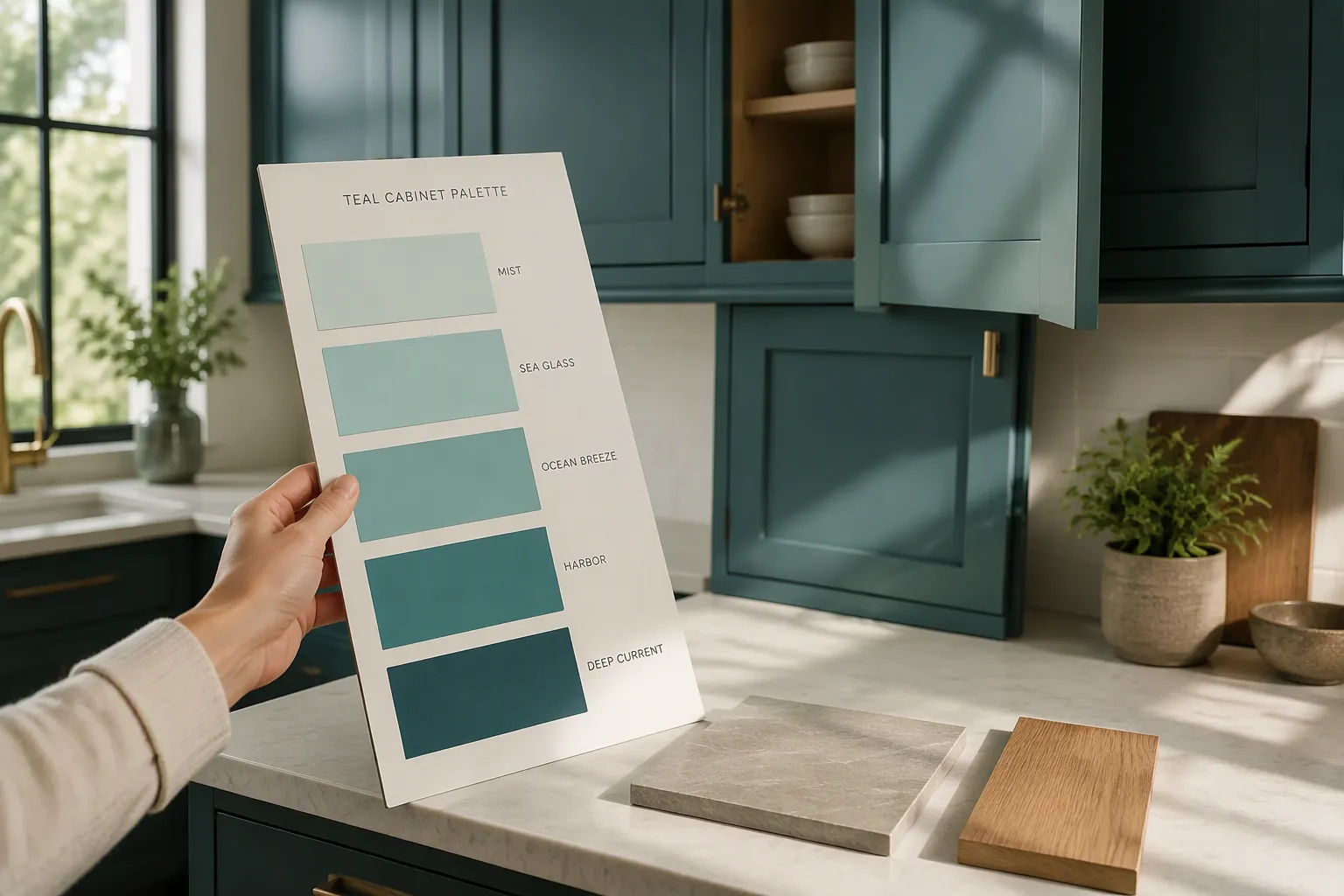
Teal kitchen cabinets cover a wide range. You can go light and airy with aqua, or you can go rich and moody with deep teal kitchen cabinets. Dark teal is often recommended as a sophisticated choice for a cool color on kitchen cabinets. It adds depth without feeling cold. Deep teal kitchen cabinets anchor a room and make other finishes pop. Light teal kitchen cabinets feel fresh and open. Either end of the spectrum works, but you need to know what you’re picking.
Warm vs. Cool Teal Undertones
An undertone is the subtle color hiding beneath the main hue. Sheen is the surface shine, and it changes how your eye reads that color. Teal has a cool base tone. You can warm it up with gold tones to make a space feel more inviting. Warm, natural textures also pair well with it. The shades of teal kitchen cabinets break down into a few families. A green undertone gives you a bold yet soft and muted look. A warm green undertone reads as a light, airy blue with a touch of warm green that brightens and calms the space. Some teal shades balance blue and green undertones evenly. Others lean into green and slate gray, a cool blue that pairs with off-whites, beige, and greige. A teal with more green than blue feels eccentric, energetic, lively, and quirky. This is where choosing the right shade of teal starts to matter. Your fixed elements, like flooring and countertops, should guide you. A green and slate gray undertone plays nicely with greige floors. A warm green undertone suits oak or walnut.
How Lighting Changes Teal
Lighting is the wild card. The same teal color kitchen cabinets can look bright at noon and almost navy at night. Morning light tends to be cooler. Afternoon sun warms everything up. Evening artificial light can shift teal toward gray or green. Test large samples in all three windows of the day. Watch how the teal shades change on your actual walls. A sample board held against your existing cabinets tells you more than a paint chip ever will. This step saves you from a costly surprise.
Teal is a confident cool-color alternative to neutral kitchen cabinets. Neutrals remain the safest common choice, and that’s fine. But teal cabinetry gives your kitchen a point of view. You get personality without repainting the whole house. Deep teal kitchen cabinets make a statement. Light teal kitchen cabinets keep things breezy. Either way, you’re choosing a color that holds its own. Deep teal kitchen cabinets work especially well on perimeter runs where the color can wrap the room. Light teal kitchen cabinets shine on islands or upper cabinets. Deep teal kitchen cabinets also hide fingerprints better than pale shades. That practical edge matters in a busy kitchen. So study your samples, note the undertone, and let the light tell you the rest.
Choosing Teal Kitchen Cabinet Coverage
Full Teal, Two-Tone, or Island Only
You have three main ways to bring teal into your kitchen. Full-color runs wrap the whole room in one shade. Two-tone layouts split the color between upper and lower cabinets. Teal kitchen islands give you a bold accent without committing the entire space. Each approach delivers a different feel, and each one suits a different room.
Start with a simple formula. For a full run, keep every cabinet in the same shade so the color reads as one calm block. For a two-tone look, try teal lowers with white or light uppers. This keeps the room bright up top and grounded below. For an island-only accent, paint the island teal and leave the perimeter neutral. You get a focal point without overwhelming the space.
Browse teal kitchen cabinet ideas and you’ll notice these three patterns repeat. The full run feels dramatic. The two-tone layout feels balanced. The island accent feels playful and easy to live with.
Matching Coverage to Kitchen Size
Your kitchen’s size and light levels should drive your coverage choice. A bright, highly saturated teal works best as an island or accent wall rather than full cabinetry. Full-kitchen saturation can overwhelm a smaller space. A light, pale teal suits broader use. It brightens compact kitchens and keeps the palette airy.
A two-tone scheme pairing a sage-green island with a clean white perimeter works well in a smaller kitchen. The contrast adds visual dimension without requiring extra square footage. That makes island-only or two-tone coverage a smarter pick than full saturation in tight spaces.
Dark teal kitchen cabinets can work in a small room too, but only on a limited run. Light teal kitchen cabinets give you more freedom to spread the color. Match your coverage to your square footage, and your teal cabinetry will feel intentional rather than crowded.
Coordinating Surfaces and Hardware
Countertops and Backsplashes
Your countertop choice sets the stage for teal kitchen cabinets. White quartz brightens the room and creates elegant contrast with teal. It resists stains and needs little upkeep, so it suits modern and classic kitchens alike. Natural marble in white, Calacatta, or Carrara adds veining and movement. It complements both dark and light teal cabinets. Butcher block in natural wood softens the boldness of teal and brings a warm Scandinavian or farmhouse feel. Black stone, whether quartz, granite, or soapstone, delivers dramatic contrast and emphasizes the depth of your cabinetry.
| Countertop Material | Color / Finish | Design Effect & Best Pairing |
|---|---|---|
| Quartz | White | Brightens the room, elegant contrast with teal; low maintenance; pairs well with gold hardware |
| Marble (natural) | White / Calacatta / Carrara | Adds veining and sophistication; complements dark and light teal cabinets |
| Butcher Block | Natural wood | Softens bold teal; warm Scandinavian or farmhouse feel |
| Black Stone | Black / dark | Dramatic contrast; emphasizes depth; pairs with matte black hardware |
For the backsplash, consider these options:
- Use white and teal patterned tiles as the backsplash.
- Pair these tiles with teal and white cabinets to create a unified look.
- Add natural wood elements and plants to make the space feel modern and fun.
If real marble stretches your budget, a removable kitchen backsplash gives you the same look without the commitment. It suits renters and anyone testing a palette before committing.
Teal Kitchen Cabinets with Gold Hardware
Teal kitchen cabinets with gold hardware create a striking, stylish combination. Gold reads as richer and more elevated than silver-toned finishes against teal. Teal already carries a calm, sophisticated mood, so gold hardware adds warmth and richness on top of it. Nickel or chrome would merely reinforce the coolness of the teal instead of complementing it. That is why so many designers reach for gold hardware here.
You do not need to match every fixture. Pairing gold cabinet pulls with a black or nickel faucet or lighting accent is an established, intentional choice. It adds depth and draws attention to architectural details. One cited kitchen paired a brushed gold faucet with matte black hardware, and the mix read as a deliberate statement rather than a clash. Brushed gold bar pulls feel especially refined on shaker doors. Gold kitchen hardware in a warmer brass tone suits transitional rooms, while a softer brushed finish keeps things contemporary. Whatever you pick, let teal and gold carry the room, and treat other metals as supporting players.
Matching Your Kitchen Style and Finish
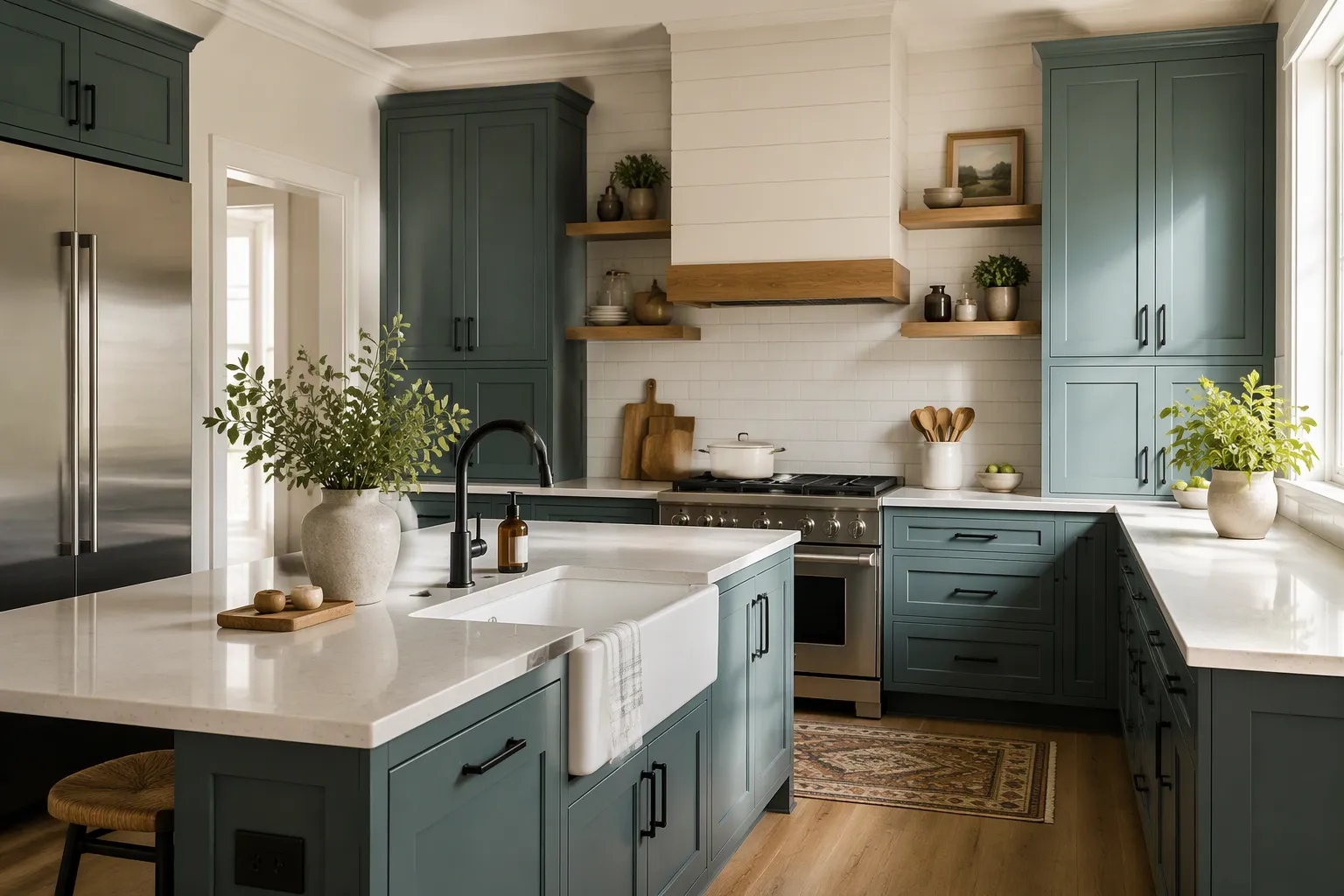
Teal is making a strong comeback in kitchen design. Kendall Jenner’s teal kitchen cabinets made headlines, and they prove what a bold design statement this color can deliver. You do not need a celebrity budget to pull it off. The trick is pairing the color with complementary shades for a cohesive look. Warm wood tones calm it down. Crisp white wakes it up. Soft gray keeps it sophisticated. Pick your partners first, then let the color lead.
Style Pairings from Modern to Farmhouse
Teal bends to almost any style. The table below shows how one color shifts with different design elements.
| Kitchen Style | Teal Cabinet Pairing | Key Design Elements |
|---|---|---|
| Modern (Minimalist) | Flat-panel teal fronts | Hidden storage, integrated appliances, clean lines |
| Farmhouse | Rustic teal finish | Reclaimed wood beams, apron sinks, antique brass hardware |
| Shaker (Transitional) | Classic shaker doors with modern finishes | Blended classic-modern look for lasting style |
| Scandinavian | Teal cabinetry | Light oak, white walls, soft textiles |
| Coastal | Teal and white doors | Woven textures, natural light |
| Contemporary Luxury | Deep teal run | Marble, oversized islands, premium lighting |
HenLeap Home carries cabinet styles that cover this whole range. You can shop modern kitchen cabinets for a clean, flat-front look. Shaker kitchen cabinets give you that transitional blend. Craftsman and country kitchen cabinets suit a warmer, more traditional room. Luxury kitchen cabinets round out the lineup for a high-end finish. A set of muted teal shaker cabinets might be your best bet if you want a look that lasts. Traditional teal kitchen cabinets with raised panels suit a period home. Modern teal kitchen cabinets with slab doors suit a loft or a new build. The door style matters as much as the shade itself.
Hardware finishes change the mood too. Matte black hardware gives you bold contrast on dark teal cabinets, and it suits contemporary, industrial, and minimalist kitchens. Natural wood handles add warmth and a handcrafted feel. They pair well with teal-stained cabinets, oak flooring, and butcher block. Brass and gold hardware highlight the green undertones for an elegant luxury look. Brushed brass, satin gold, and champagne bronze all work. Gray accents create sophisticated contemporary and transitional interiors, and light gray walls let the color stand out.
Choosing Paint Sheen and Finish
Sheen is the surface shine of your finish, and it changes how your eye reads the color. A matte finish absorbs light and makes deep teal look velvety and rich. Satin sits in the middle. It wipes clean easily and holds up well in a busy kitchen. Semi-gloss reflects more light and makes the color look brighter and more saturated. Gloss finishes feel sleek and modern, but they show every fingerprint.
Think about texture as well as shine. Antique and distressed finishes bring vintage charm to farmhouse and cottage styles. Pair them with reclaimed wood shelving, bronze hardware, and ceramic accessories. A smooth factory finish suits a crisp modern room. A hand-rubbed look suits a room with character.
Your hardware choice should match the sheen you pick. Gold hardware on a satin finish reads warm and refined. Gold hardware on a matte finish feels more understated. If you want a softer look, brushed gold hardware blends into the color instead of popping against it. Polished gold hardware makes a bolder statement. You can also mix metals. Gold hardware next to a black faucet is a deliberate, stylish choice. Just keep the scale of your pulls in proportion to your door style. Slim bar pulls suit flat panels. Cup pulls suit shaker doors. Round knobs suit both.
If you love gold hardware, start with the pulls and work outward. Gold hardware pairs well with every style on that list. Your teal cabinetry deserves a finish that fits your light levels and your cleaning habits. A satin finish is the practical default for most homes. A matte finish rewards you with depth if your kitchen gets soft, indirect light. HenLeap Home offers finishes across its modern, shaker, craftsman, country, and luxury lines, so you can match a sheen to the room you actually live in.
Avoiding Common Teal Cabinet Mistakes
Shade and Sample Errors
The biggest mistake you can make is choosing a teal from a tiny paint chip. Small chips hide undertones and sheen. Order a large sample instead. Hold it against your actual wall, your flooring, and your countertop. A big sample shows you how the color truly behaves in your room.
Ignoring lighting is another common slip. That teal you loved in the store may look gray in your kitchen at night. Watch your sample in morning, afternoon, and evening light. Check it under your real bulbs too. If the shade shifts in a way you dislike, pick a different one now. Fixing it later costs far more.
A shade that clashes with fixed elements is a third trap. Your floors, countertops, and backsplash are not going anywhere. A teal with a strong green undertone can fight a cool gray floor. Bring samples of those fixed surfaces with you when you shop for teal kitchen cabinets. Let them vote on the final choice.
Coordination and Proportion Pitfalls
Overusing teal in a small space is a real risk. A full run of saturated teal cabinets can make a compact kitchen feel closed in. Try an island-only accent or a two-tone layout instead. Light teal cabinets on uppers keep a small room open and bright.
Mismatched hardware scale is the other quiet mistake. Tiny knobs on wide shaker doors look lost. Oversized pulls on slim modern fronts look clumsy. Match the pull length to your door width and the knob size to your drawer depth. Hold hardware samples against your door style before you commit. Good proportions make teal cabinets look custom. Poor ones make even a great shade feel off.
Cost and Maintenance with HenLeap Home
Budgeting for Teal Cabinets
Your budget depends on three things: paint versus factory finish, how much coverage you choose, and your hardware. A factory finish costs more up front, yet it holds its color and sheen far longer than a site-painted job. Full teal runs use more material than an island-only accent. Hardware adds up too, so price your pulls before you fall for a finish.
HenLeap Home exists to make premium cabinetry accessible and affordable. You get soft-close doors and drawers, reinforced construction, and durable dovetail drawers without a luxury markup. The team also handles on-site measurement, 2D and 3D virtual designs, delivery, and after-sales support. That full package keeps your custom teal kitchen cabinets on schedule and on budget.
Keeping Teal Cabinets Looking Fresh
A little routine care keeps teal cabinets vivid for years. Dust with a soft, dry microfiber cloth, and wipe spills right away near the sink and dishwasher. For daily cleaning, use a damp cloth with mild soap, then dry the surface completely. Skip bleach, ammonia, citrus cleaners, and anything abrasive.
A few habits protect the finish:
- Use drawer liners to prevent scratches and scuffs.
- Run the hood fan while cooking to limit grease buildup.
- Check hinges and hardware for loosening, and tighten as needed.
- Keep heavy items in lower cabinets to avoid straining hinges.
- Touch up chips with a matching paint kit.
To maintain and care for teal kitchen cabinets, deep-clean inside and out once a year. Test any new cleaner on a hidden spot first. Manage humidity with your HVAC system, and leave doors slightly open after a heavy cleaning. These small steps keep your painted teal cabinets looking sharp.
You now have a clear path. Start with shade and undertone. Test samples in morning, afternoon, and evening light. Decide your coverage: full teal, two-tone, or island only. Then coordinate countertops, backsplash, and gold hardware. Match your style and finish, and dodge the common mistakes. Thoughtful planning, not guesswork, turns teal kitchen cabinets into a lasting feature of your dream kitchen. Explore HenLeap Home for more inspiration and product guidance. Grab a few large samples of teal cabinets today, tape them to your wall, and start planning your space with confidence.
FAQ
What is the best shade of teal for kitchen cabinets?
There is no single best shade. Deep teal reads sophisticated and hides fingerprints well. Light teal keeps a room airy and bright. Let your flooring and countertops guide you, then test large samples in your own light before you commit.
Do teal kitchen cabinets make a kitchen look smaller?
They can, if you saturate a small or dark room. Try an island-only accent or teal lowers with white uppers instead. Light teal on upper cabinets keeps a compact space open and bright. Match your coverage to your square footage.
What color hardware works best with teal cabinets?
Gold hardware is the standout pairing. It adds warmth and richness against the cool teal base. Matte black delivers bold contrast, and natural wood handles feel handcrafted. Brushed brass and champagne bronze also work well. Keep pull size in proportion to your door style.
Will teal cabinets go out of style?
Teal has deep roots in kitchen design, and it keeps returning in fresh forms. A muted shade on classic shaker doors ages better than a trendy neon tone. Choose a timeless door style and a finish you love, and your cabinets will hold up for years.
How do I keep teal cabinets from fading or showing wear?
Dust with a soft microfiber cloth, wipe spills right away, and clean with mild soap and water. Skip bleach, ammonia, and citrus cleaners. A factory finish holds its color longer than site paint. Touch up chips with a matching paint kit.