
You walk into a kitchen, and the cabinets greet you first. Their color, grain, and weight set the mood before you touch a single drawer. That is why solid wood kitchen cabinets remain the top choice for homeowners who want a timeless look and real durability. Solid wood lasts up to 30 years or more, while MDF and particleboard often last 10 to 15 years. This guide shares practical tips on species, joinery, finishes, hardware, layout, lighting, and care. HenLeap Homeoffers trusted guidance for your project, so you can build cabinets that stay beautiful and strong.
Key Takeaways
- Solid wood cabinets last 30 to 50 years with simple care, while particleboard often fails in 5 to 10 years.
- Choose hardwoods like maple or oak for busy kitchens; they resist dents and wear better than soft woods.
- Quality joinery, such as dovetail drawers and mortise-and-tenon doors, ensures your cabinets stay strong for decades.
- A durable topcoat like conversion varnish protects against moisture, stains, and daily use.
- Smart layout and lighting make your kitchen efficient and highlight the natural beauty of wood.
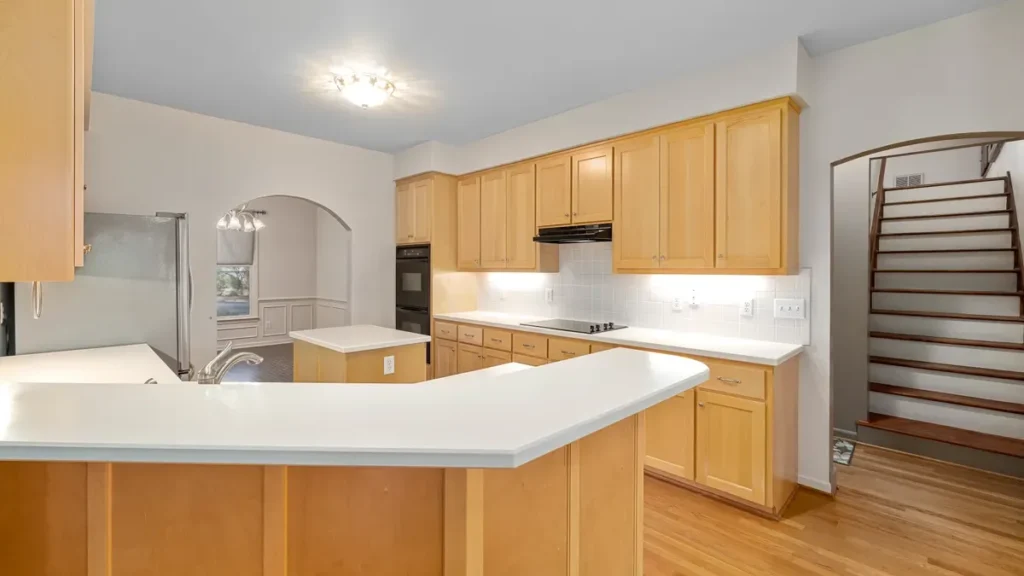
What Solid Wood Kitchen Cabinets Really Mean
When you hear the term solid wood kitchen cabinets, it means the visible parts come from genuine hardwood. The doors, drawer fronts, and face frames use real lumber from species like maple, cherry, or walnut. The cabinet boxes and shelves typically use plywood or other engineered wood for stability. This combination gives you natural wood beauty where it matters most and structural reliability where strength counts.
Solid Wood vs. Engineered and Veneered Options
Knowing your material options helps you choose wisely. Here is a comparison:
| Material | Construction | Typical Use |
|---|---|---|
| Solid Wood | Real hardwood boards (oak, maple, cherry) | Doors, drawer fronts, face frames |
| Engineered Wood | Plywood, MDF, or particle board (wood fibers + resin) | Cabinet boxes, shelves, painted doors |
| Veneered | Engineered core with thin real wood veneer | Stain-grade doors and panels |
Solid wood fronts give your kitchen rich grain and natural warmth that synthetic materials cannot replicate. Engineered wood, especially plywood, resists warping better than solid hardwood in large panels. Veneered options look like wood at first, but moisture can bubble the thin layer over time.
Why Solid Wood Delivers Timeless Toughness
Solid hardwood brings unmatched durability to your kitchen. With basic refinishing every five years, solid wood cabinets can last over 50 years. That kind of longevity means you invest once and enjoy beauty for decades. Particle board cabinets often fail structurally within 5 to 10 years, especially in humid kitchens.
The craftsmanship behind solid wood also matters. Each door and drawer front shows the natural grain. You can sand and refinish them multiple times, changing the color as your style evolves. Synthetic materials cannot offer that second life.
Solid wood also wins on environmental impact. Trees absorb CO₂ as they grow, making wood carbon-negative. At end-of-life, solid wood biodegrades naturally. Synthetic materials create non-biodegradable waste that persists for centuries.
Choosing the Right Wood Species
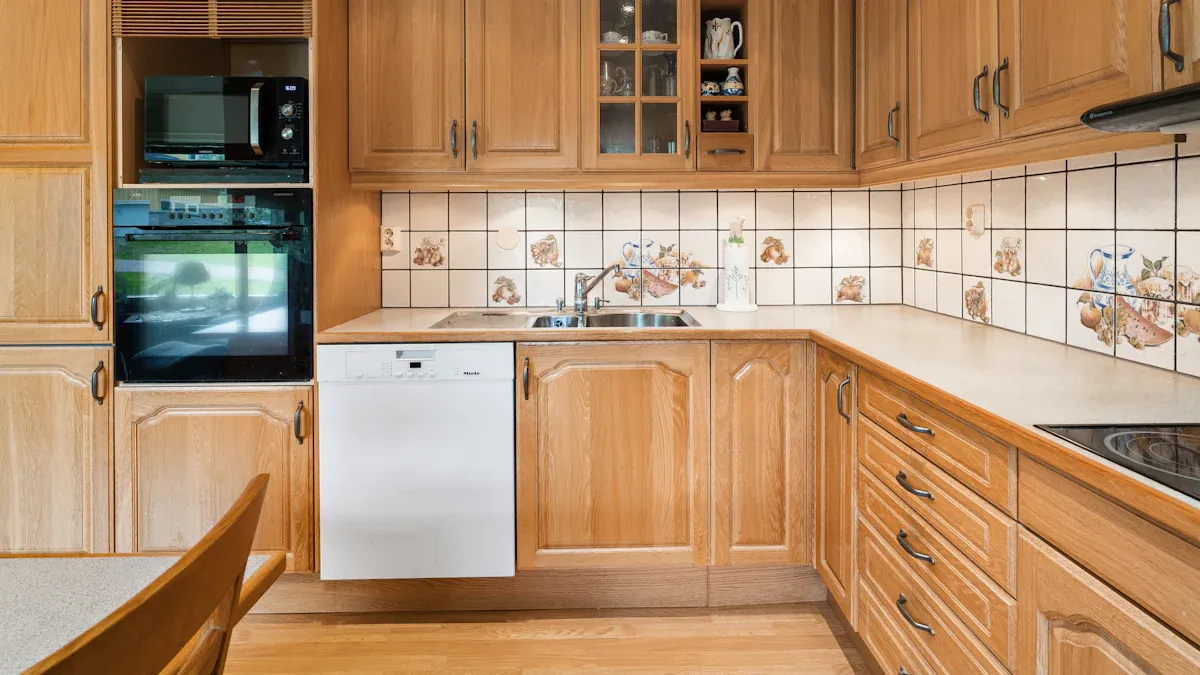
Picking the right wood species shapes how your kitchen looks and performs for decades. When selecting species, you balance hardness, grain pattern, cost, and climate. The Janka scale measures wood hardness, and harder woods resist dents better in busy kitchens.
Hardwoods for Durability: Oak, Maple, and Cherry
Oak, maple, and cherry stand as timeless hardwood choices. Each offers durability and an aesthetic that never goes out of style.
| Wood | Janka Hardness (lbf) | Key Characteristics |
|---|---|---|
| Maple | 1,450 | Smooth grain, very durable, ideal for painted cabinets |
| Oak (White/Red) | 1,290–1,360 | Strong visible grain, excellent moisture resistance |
| Cherry | 950 | Rich color that deepens with age, elegant look |
Maple suits shaker style designs because its closed grain takes paint beautifully. Oak works well for country kitchens with its bold grain. Cherry brings warmth to luxury kitchen cabinets. HenLeap Home offers shaker cabinets, modern, country, and luxury styles to match your chosen species. The brand also provides on-site measurement and 2D/3D virtual designs, so you can visualize your selected wood before committing.
Softer and Budget-Friendly Options: Pine and Birch
Pine and birch offer affordable alternatives for budget-conscious projects. Each brings distinct trade-offs.
| Criterion | Pine | Birch |
|---|---|---|
| Janka Hardness | 420–680 (soft) | 1,260 (moderately hard) |
| Scratch Resistance | Poor — dents easily | Better than pine |
| Moisture Resistance | Poor — warps with humidity | Good — closed grain |
| Best Use | Painted finishes, low-use kitchens | Stained or painted cabinetry |
Birch resists moisture well and holds up better over time. Pine suits cottage aesthetics but needs careful handling.
Birch has a fine grain and pale color. It is harder than alder and poplar, so it holds up better over time. You can stain or paint birch, but stain may appear uneven unless you seal the surface first. These woods work best for painted finishes or kitchens without heavy use. They deliver a simple look at a lower cost. For custom cabinetry built with quality materials, selecting species wisely ensures your investment lasts.
Joinery and Construction That Last
Great cabinets hide their genius in the joints. You can see the wood species and finish, but the real durability lives in how the parts connect. This section breaks down the frame, door, and drawer box basics, then shows you which joinery methods hold up for decades.
Frame, Door, and Drawer Box Basics
A solid cabinet starts with a strong frame. The face frame gives your kitchen its structure and holds the doors in alignment. Five-piece door construction uses two vertical stiles, two horizontal rails, and a floating center panel. That floating panel moves with humidity changes, so your door stays flat instead of warping. Doors taller than 50 inches need a center horizontal rail; without it, gravitational stress and moisture absorption cause warping that voids most manufacturer warranties.
Drawer boxes matter just as much. Premium drawers use 5/8-inch thick solid hardwood sides with dovetail pin angles between 7 and 14 degrees. Economy drawers use thinner 1/2-inch plywood or particleboard with stapled butt joints. Those thin metal fasteners rely on limited shear strength, loosen over time, and cause the drawer to rack and detach.
Joinery Methods That Stand the Test of Time
Different joints serve different purposes. The table below compares the most common methods.
| Joint Type | Typical Application | Strength Rating | Skill Level | Production Speed |
|---|---|---|---|---|
| Mortise & Tenon | Door frames, face frames | Excellent | Advanced | Moderate |
| Dovetail | Drawer boxes, carcass corners | Excellent | Advanced | Slow (hand) / Fast (CNC) |
| Dowel | Face frames, carcass assembly | Very Good | Intermediate | Fast |
| Dado & Rabbet | Shelves, back panels | Good | Beginner | Very Fast |
| Pocket Screw | Face frames, quick assembly | Good | Beginner | Very Fast |
| Floating Tenon | Mid-panel, frame assembly | Excellent | Intermediate | Fast |
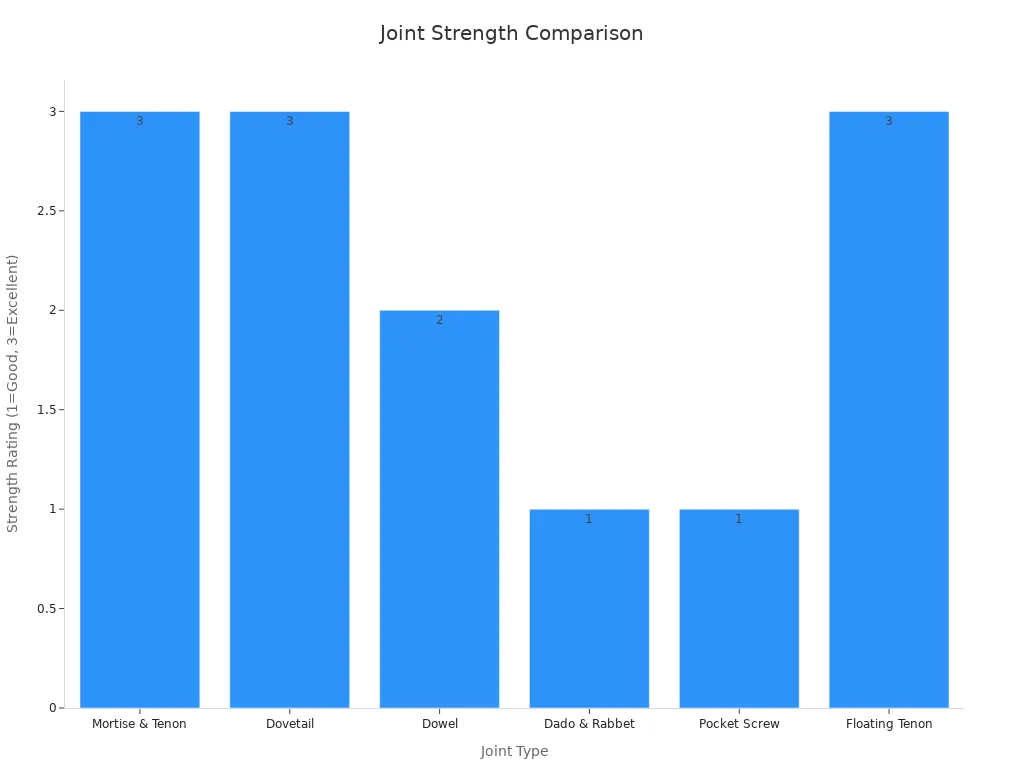
Mortise-and-tenon joints provide the strongest connection for Shaker door frames, offering superior resistance to racking forces compared to dowels or pocket screws. When properly executed with 1/4″ tenons for 3/4″ material and adequate glue surface, mortise-and-tenon joints can withstand decades of door operation without loosening. Draw-bored mortise-and-tenon joints using offset wooden pegs create mechanical locks that do not rely solely on adhesive and strengthen over time as wood fibers compress.
Dovetailed solid wood drawer boxes support 100+ pound loads through 100,000+ operational cycles without joint failure. By contrast, stapled construction typically fails between 50–75 pounds or shows joint separation after 25,000 cycles. The mechanical interlocking of dovetails means even if adhesive degrades over time, the joint geometry continues providing structural support.
Dovetail joinery is the gold standard for drawer boxes. The interlocking, flared wood pins and tails form a trapezoidal geometry that tightens under tension. The harder you pull the drawer front, the more securely the joint locks. This drastically reduces dependence on glue, which degrades over decades of thermal cycling and humidity changes. For five-piece doors, the joint where stile meets rail is the single most critical stress point. Premium doors use cope-and-stick joinery: precisely matched router profiles create an interlocking mechanical bond that exponentially increases glue surface area while physically capturing the center panel.
Pocket screws work professionally when you combine them with glue. Use 1-1/4″ screws for 3/4″ stock, space holes at 6–8″ intervals with a minimum of two per joint, and always add wood glue so screws provide clamping pressure while glue creates permanent bonds. Avoid pocket screws for primary structural joints under tension, visible surfaces requiring plugs, and door frames where mortise-and-tenon is preferred. Pocket screws are acceptable for face frames when positioned on the backside where invisible.
HenLeap Home uses reinforced cabinet construction and durable dovetail drawer construction. That quality craftsmanship shows in every joint. The brand’s robust construction meets professional standards, and the strength of these methods directly enhances durability. KCMA certification validates these claims through independent testing. Certified cabinets must survive 25,000 door and drawer cycles, 600-pound wall cabinet loading, and chemical resistance tests. AWI Custom Grade specifications establish the professional baseline, requiring 1/2″ minimum back panels, dado and rabbet joinery, and color-matched edgebanding. CNC precision eliminates human error in joinery execution, cutting mortises, tenons, and dovetails with repeatability measured in thousandths of inches. When you invest in solid wood kitchen cabinets with this level of joinery and construction, you build a kitchen that stays beautiful and strong for generations.
Timeless Cabinet Design Features
You want a kitchen that feels warm and grounded, not cold and sterile. Bright white cabinets can look sharp, but they often wash out a room and date quickly. Solid wood fronts bring depth of grain, tone, and texture that warm up your space and add lasting appeal. These timeless cabinet design features keep your kitchen relevant for decades.
Classic Proportions and Grain-First Aesthetics
Great cabinet design starts with balance. The classic shaker style uses a five-piece door with a flat recessed center panel and simple rails and stiles. Clean lines and balanced proportions make this look flexible enough for traditional, transitional, and modern homes. Slim shaker cabinets keep that core structure but narrow the frames for a refined, contemporary feel. You can also choose simple slab cabinets with flat surfaces and clean geometric lines for a modern touch.
Proportion rules shape how pleasing a door looks. Slim shaker frames narrow from the traditional 2.5–3 inches down to 1.5–2 inches, which produces golden-ratio relationships between frame and door center. Those proportions feel naturally balanced to the human eye, so the style stays harmonious over time.
| Design Element | How It Is Applied | Effect on Timeless Look |
|---|---|---|
| Golden ratio in door proportions | Slim shaker frames narrow from 2.5–3 inches to 1.5–2 inches, creating golden-ratio relationships between frame and door center | Proportions feel naturally balanced and pleasing, helping the door style remain visually harmonious over time |
| Grain orientation in solid wood | Vertical grain in stiles and horizontal grain in rails, following a strict pattern | Maximizes structural strength and minimizes seasonal wood movement, supporting durability and a classic appearance |
Grain orientation matters just as much. Vertical grain in stiles and horizontal grain in rails follows a strict pattern. This approach maximizes structural strength and minimizes seasonal wood movement. You get both durability and a classic, enduring appearance.
Mixing a Wood Island with Contrasting Perimeter Cabinets
A wood island paired with contrasting perimeter cabinets creates a furniture-like feel. Picture a rich cherry or oak island standing against painted or lighter perimeter cabinets. The contrast draws the eye to the island as a focal point, much like a freestanding table in a dining room. This approach keeps solid wood cabinets from feeling heavy or uniform.
You can pair polished chrome hardware with modern or retro designs. Oil-rubbed bronze brings Old-World charm that ages gracefully with a natural patina. Matte black complements modern, industrial, and minimalist designs without overpowering light cabinetry. Antique brass or satin brass adds warm, inviting tones that suit both vintage and modern aesthetics.
Tailor your choices to your home’s architecture. Shaker cabinets and natural wood finishes suit traditional homes. Sleek frameless cabinets in neutral tones work for contemporary spaces. Reclaimed or distressed wood fits rustic settings. Soft-close hinges, integrated lighting, and custom organization blend modern convenience with traditional craftsmanship. These choices keep your solid wood kitchen cabinets relevant for decades.
Finishes That Protect and Beautify
High-quality materials and expert craftsmanship form the foundation of a timeless kitchen. The finish you chooseprotects your investment and shapes how your cabinets age. A durable finish locks in color, resists moisture, and adds visual depth that makes wood grain come alive.
Stains, Paints, and Natural Oils Compared
Each finish approach offers different protection and style. A penetrating oil like tung or linseed soaks into wood fibers and leaves almost no surface film. This enhances natural grain depth but provides minimal moisture protection. Wax delivers a soft hand feel with low sheen, yet it offers minimal moisture resistance. Water-based clear coats form a thin, hard, transparent film that protects wood while keeping color and grain visible.
Stain application follows a clear process. Sand the wood progressively up to a fine 220 grit, then remove all dust. Apply stain with a lint-free cloth or brush, let it sit a few minutes, then wipe off the excess. Build color with multiple thin coats rather than one heavy coat for a more even result. Paint requires sanding and priming first to ensure adhesion and longevity. Painted, stained, and glazed surfaces all need a protective topcoat to lock in color and resist daily handling.
Topcoats and Sealants for Everyday Toughness
The topcoat determines how well your cabinets survive real kitchen conditions. Conversion varnish provides the hardest film with excellent moisture resistance and strong stain resistance. It handles grease, cleaning chemicals, and steam far better than water-based alternatives. Two-component polyurethane comes close in hardness and chemical resistance, resisting scratches and household cleaners without softening under heat. Waterborne polyurethane offers eco-friendly performance with moderate durability, though it is slightly softer than conversion varnish or 2K systems.
For busy households with children, conversion varnish and 2K polyurethane deliver long-lasting protection. Pair your topcoat correctly: acrylic latex paint with water-based polyurethane, oil-based enamel with oil-based polyurethane, and oil-based stain with oil-based polyurethane. This pairing ensures proper adhesion and maximum durability for your solid wood kitchen cabinets.
Hardware and Ergonomic Design with HenLeap Home
Hardware determines how your cabinets feel every single day. A door that closes with a soft thud and a drawer that glides shut on its own tells you the cabinet was built with care. HenLeap Home equips its cabinets with soft-close doors and drawers, so you get that everyday-friendly experience from the start.
Durable Hinges, Slides, and Pulls
Concealed European-style hinges have become the industry standard for modern cabinets. They mount invisibly and offer three-way adjustment, so you can fine-tune door alignment over time. Soft-close hinges add dampening mechanisms that prevent slamming and reduce wear on the cabinet frame.
| Component | Key Specification | Industry Standard Value |
|---|---|---|
| Hinges | Concealed European-style with soft-close | Premium: 200,000 cycles; Mid-tier: 80,000–150,000; Economy: 25,000–50,000 |
| Drawer Slides | Under-mount full-extension with soft-close | Blum TANDEM plus BLUMOTION: 100,000 cycles, 90 lbs standard, 125 lbs heavy-duty |
| Pulls | Solid brass or stainless steel (316/304) | Durability rating 9–10/10; avoid plated in humid environments |
Quality soft-close slides from Blum or Grass maintain consistent action for 10–15 years of daily use. Cheap slides may lose their damping within 3–5 years. When a soft-close slide loses its damping feel, replace the entire slide rather than repairing it.
Blum hardware is durable, precisely adjustable, and has the most extensive range of configurations. Grass quality and durability are equivalent to Blum. For a kitchen renovation intended to last 20 or more years, specifying Blum or Grass hardware is the most reliable choice.
Ergonomics That Make Daily Use Effortless
Ergonomic placement of pulls, drawers, and shelves improves how you move through your kitchen. Place drawer pulls near the top edge of the drawer front, so your hand finds them without bending. Position wall cabinet pulls at the bottom edge for easy reach. Install pull-out shelves in base cabinets to bring items forward instead of making you crouch and dig.
Drawer stacks work best when you assign heights by function. Reserve deep drawers for pots and small appliances. Use shallow drawers for utensils and linens. This approach supports both shaker style simplicity and modern efficiency. Timeless kitchen hardware finishes like oil-rubbed bronze or satin brass also age gracefully and hide fingerprints better than polished chrome.
Layout and Storage for a Functional Kitchen
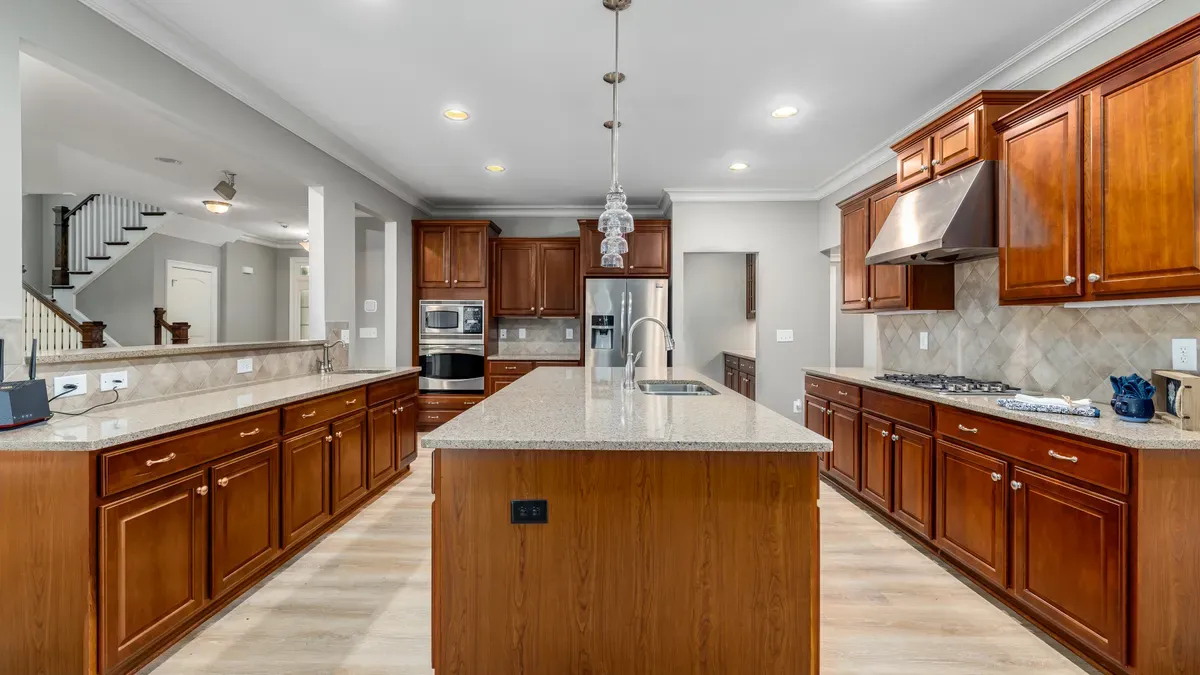
A smart layout keeps your kitchen efficient without sacrificing its timeless look. Start with the work triangle. Position your stove, refrigerator, and sink so each leg measures between 4 and 9 feet, with a total distance of 26 feet or less. This arrangement minimizes steps and keeps your workflow smooth. L-shaped, U-shaped, and galley layouts all support this principle well.
Smart Cabinet Layouts for Flow and Efficiency
Create distinct zones for prep, cooking, and cleaning. Give each zone ample counter space and nearby storage for pots, pans, and dishes. This approach keeps your cabinet design practical and uncluttered. Shaker-style solid wood cabinets work beautifully here because their clean lines suit any layout.
Layered lighting completes the picture. Combine overhead fixtures with under-cabinet task lights and pendants over an island. This mix illuminates work areas and adds visual interest without trendy gimmicks. Simple, classic hardware shapes in polished nickel or unlacquered brass coordinate well with wood cabinets and resist dating.
Storage Solutions That Maximize Every Inch
Pull-out systems with full-extension slides bring contents forward. You gain complete access without removing front-row items. Corner solutions like lazy Susans and magic corners convert awkward recesses into prime storage. Deep drawers with custom dividers provide stacked storage and easy top-down access.
| Storage Solution | Mechanism | Key Benefit |
|---|---|---|
| Pull-out systems | Full-extension slides | Complete access to deep interiors |
| Corner solutions | Lazy Susans, magic corners | Convert wasted corners into usable space |
| Deep drawers | Dividers, organizers | Stacked storage with top-down access |
Premium solid hardwoods and furniture-grade plywood resist warping and cracking. Dovetail joinery and precision-fit components exceed stock cabinet standards. These custom storage solutions protect your investment for decades. Whether you need custom cabinetry for kitchens or other rooms, quality materials and smart organization deliver lasting value.
Lighting and Color Strategies
Lighting That Highlights Wood Grain and Warmth
Lighting acts as a filter between your wood cabinets and your eyes. Wood has grain, pores, and natural variation that reflect and absorb light in complex ways. Brighter light increases the visibility of grain and texture, while dim light flattens the look. Warm evening lighting deepens color and pulls out warmer undertones, sometimes making cabinets look more golden than they did in the showroom.
Choose warm white bulbs in the 2700K to 3000K range to enhance the warm tones of light wood cabinets. This temperature makes red oak and cherry tones look richer. Neutral white at 3500K to 4000K shows a truer wood tone and works well for white oak and natural finishes. Cool white above 5000K pulls out gray undertones and can make warm woods feel washed out. Look for a CRI of 90 or higher, because high CRI helps wood and counters look true to their real color.
Install under-cabinet LED strip lighting to illuminate countertops and accentuate cabinet grain. Add dimmers so you can adjust brightness for showing wood patterns. Accent lighting inside glass-front cabinets or spotlights aimed at the backsplash highlights wood texture. Toe-kick lighting along the base creates a floating effect and draws attention to cabinet form. Maximize natural light through window placement to make grain patterns more visible.
Timeless Color Palettes That Pair with Solid Wood
The right wall color complements your wood instead of competing with it. Warm taupe sits between beige and gray, feels relaxed, and hides wear better than lighter tones. Soft gray reads clean but not cold and blends with both light and dark woods. Sage green conveys a natural, earthy feel and pairs nicely with wood shelving. Cream adds softness and reflects light well.
| Paint Color Family | Why It Pairs Well | Recommended Shades |
|---|---|---|
| Warm taupe | Relaxed, hides wear | Sherwin-Williams Accessible Beige SW-7036; Benjamin Moore Natural Cream OC-14 |
| Soft gray | Clean but not cold | Benjamin Moore Classic Gray OC-23; Sherwin-Williams Repose Gray SW-7015 |
| Sage green | Natural, earthy feel | Sherwin-Williams Svelte Sage SW-6164; Benjamin Moore Hazy Skies OC-48 |
| Cream | Soft, reflects light | Benjamin Moore White Dove OC-17; Sherwin-Williams Snowbound SW-7004 |
These palettes support a timeless look that stays relevant for decades. They also suit shaker style cabinets, whose clean lines let the wood grain and wall color work together without visual clutter.
Built to Last for Generations: Sustainability and Care
Solid wood kitchen cabinets deliver remarkable longevity when you choose quality materials and follow smart care and maintenance habits. These cabinets resist daily wear, hold their structural strength for decades, and adapt to your changing style through refinishing. With proper attention, your investment will be built to last for generations.
Eco-Friendly Sourcing and Finishes
Responsible sourcing starts with FSC-certified wood. This certification confirms your cabinets come from responsibly managed forests that protect biodiversity and support sustainable harvesting. Low-VOC finishes complete the picture by minimizing off-gassing and improving indoor air quality. Together, these practices create a healthier kitchen with minimal environmental impact.
Look for third-party certifications when selecting materials. GreenGuard provides independent verification of low emissions standards. CARB Phase 2 compliance documents demonstrate formaldehyde emission limits of 0.11 ppm. Water-based paints and sealers now match traditional solvent-based products without harmful off-gassing.
Water-based does not automatically mean low-VOC. Always ask for certification documentation. Adhesives often contain high VOCs even when other materials meet standards.
A Simple Maintenance Routine for Decades of Beauty
A consistent routine preserves your cabinets for years. Follow these steps:
- Wipe surfaces weekly with a soft, damp cloth and mild dish soap. Work along the grain, then dry immediately.
- Apply furniture polish or wood conditioner every 3–4 months to prevent drying and cracking.
- Inspect for damage every 6–12 months. Check hinges, handles, and finishes for wear.
- Control humidity to reduce seasonal wood movement and prevent warping.
Avoid ammonia-based cleaners, bleach, vinegar, and abrasive pads. Spray cleaner onto your cloth first, never directly onto cabinets. This prevents liquid from seeping into seams and hardware. With this simple care and maintenanceapproach, your long-lasting custom cabinetry stays beautiful for decades.
You now hold a complete playbook for solid wood kitchen cabinets. Species choice sets durability and tone. Joinery and construction decide structural strength. Finishes protect the surface. Hardware shapes daily feel. Layout, lighting, and simple maintenance keep everything working and beautiful. Apply these tips step by step, and your kitchen becomes an investment built to last for generations.
Treat quality custom cabinetry as a long-term decision, not a quick purchase. HenLeap Home stands ready as your partner, guiding you from measurement to installation. Start your enduring kitchen today.
FAQ
How long do solid wood kitchen cabinets last?
You can expect solid wood cabinets to last 30 years or more. With basic refinishing every five years, they can serve your kitchen for over 50 years. Particle board cabinets often fail within 5 to 10 years, especially in humid spaces.
Which wood species works best for busy family kitchens?
Maple and oak handle heavy daily use well. Maple rates 1,450 on the Janka scale, and oak ranges from 1,290 to 1,360. Both resist dents better than softer woods. Cherry offers elegance at 950 but needs gentler handling.
Do solid wood cabinets warp in humid climates?
Solid wood moves with humidity changes, but quality construction manages this. Five-piece doors use a floating center panel that expands and contracts freely. Plywood cabinet boxes add stability. Control indoor humidity to reduce seasonal movement and prevent warping.
What finish protects cabinets best in a busy kitchen?
Conversion varnish delivers the hardest film with excellent moisture and stain resistance. Two-component polyurethane comes close and resists scratches well. For households with children, these topcoats outperform water-based options. Always pair your topcoat correctly with your stain or paint base.
Can you refinish solid wood cabinets instead of replacing them?
Yes. Solid wood accepts sanding and refinishing multiple times. You can change the color as your style evolves. This second life sets solid wood apart from veneered or engineered options, which cannot withstand repeated refinishing.